
Checking Criminal History in Jamestown
Begin with the event, not a broad name search. Jamestown Police Department records are the best first stop for an incident investigated by city officers. Jamestown City Court is the source for a local criminal case, scheduled appearance, or certificate of disposition. The Chautauqua County Sheriff holds county jail custody records, while an indicted felony moves to County Court in Mayville. New York eCourts can help locate an active matter, but it does not display warrants, sealed cases, or finished cases. Each channel has a narrow job.
- Ask Jamestown Police Records Management for the incident, arrest, traffic, or crash record tied to the event.
- Use the Jamestown City Clerk FOIL route when a city agency record requires a written public-record request.
- Contact Jamestown City Court for its docket, filed charges, appearances, and final disposition.
- Check county custody and court sources if the person was booked or the felony case advanced to Mayville.
- Use OCA CHRS for a paid statewide public court-history search, or DCJS Personal Record Review for your own fingerprint-linked rap sheet.
Those last state routes are not substitutes for a city report. CHRS matches an exact name and date of birth against eligible public court data. DCJS limits Personal Record Review to the person whose fingerprints are submitted. A full Chautauqua County criminal-history check may require both local and state records.
Jamestown Police Record Fees
Jamestown publishes a specific fee schedule for common police records. This makes the request path clearer than in many cities, but the requester still must identify the right product. A crash report is not an incident search, and an archive search applies when a record predates 1995. The city fee page is the source for the amounts below and should be checked before a request.
| Jamestown record service | Published fee |
|---|---|
| Accident report | $10 |
| Police or incident search | $12 |
| Pre-1995 archive search | $20 |
| Expedited service | $25 |
| Individual check | $20 |
| Fingerprint card | $30 per card |
The captured Jamestown fee page shows how the city distinguishes these local record products.
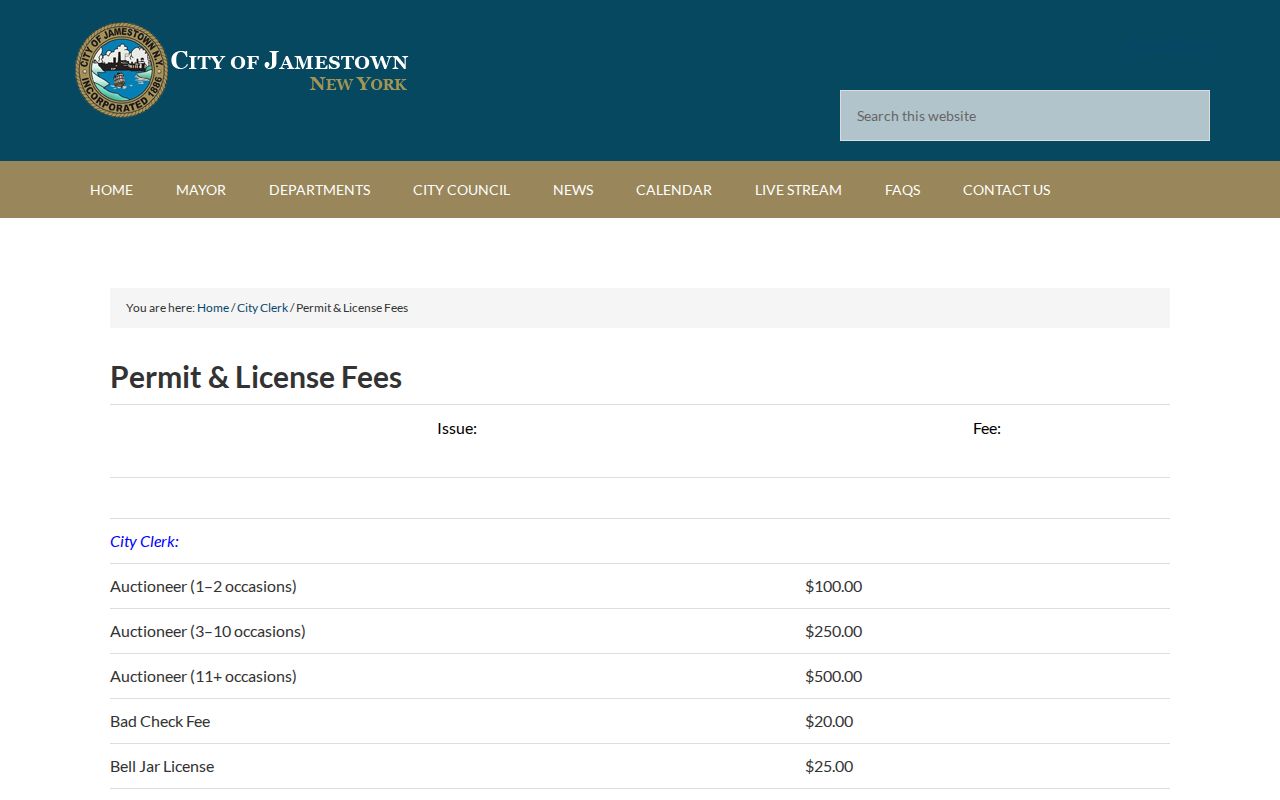
That distinction matters when asking for a record: describe the event and desired document instead of requesting a vague background file.
Jamestown Police Department Records
The Jamestown Police Department is at 201 East Second Street. Its main number is 716-483-7536, the tip line is 716-483-8477, and its email is info@jpdny.com. The department reports 62 sworn members and eight civilian staff. Three Records Management civilians maintain arrest, case-history, traffic, and crash files. This is a real records function, separate from patrol and dispatch.
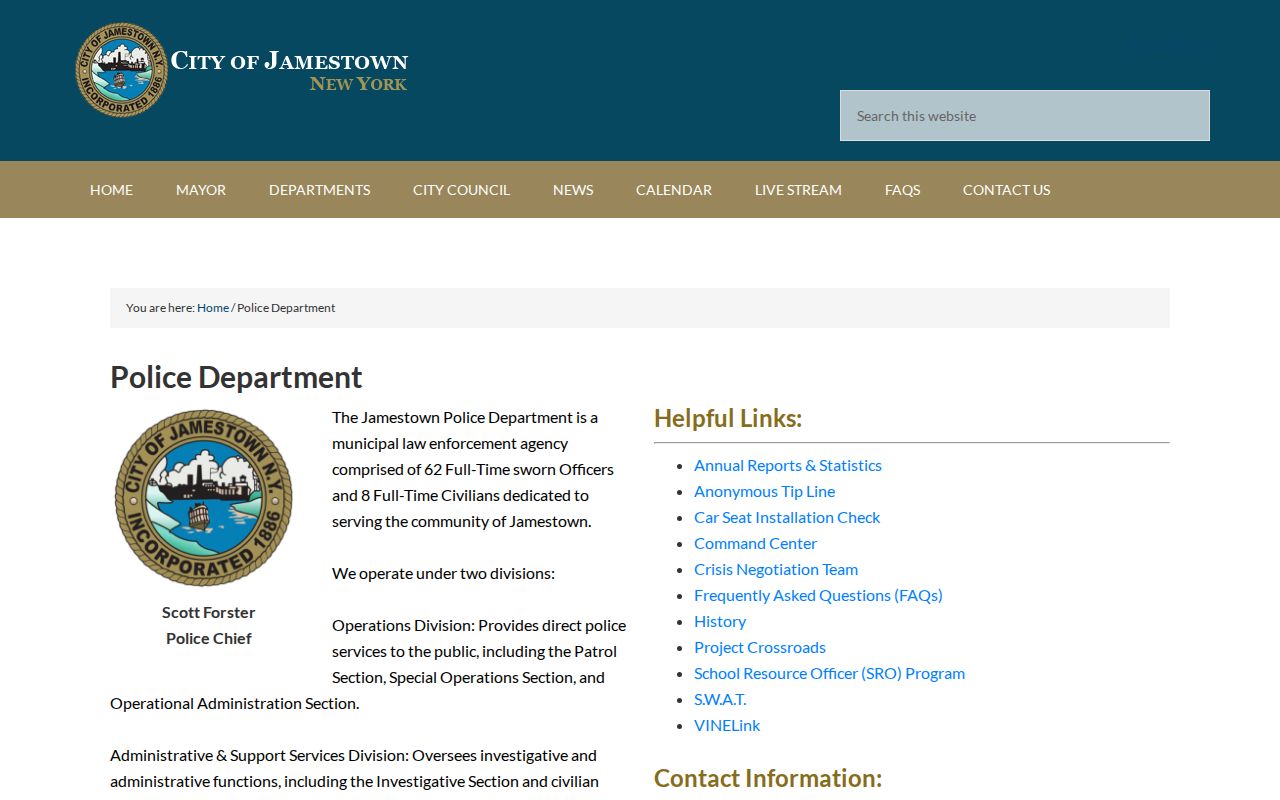
The official department view connects Jamestown requesters to the office that created and maintains city police records.
The Command Center is staffed around the clock, but that does not mean every records service is a 24-hour counter service. For a serious crime or a crash involving more than $1,000 in damage, city instructions say to call reception and choose option 0 so an officer can make a report. The record comes later, after the event is documented and reviewed. Ask Records Management about release and search details rather than treating the emergency or tip channel as a record-request line.
Jamestown FOIL Record Requests
Some Jamestown criminal records require a written request through the City Clerk. The Jamestown FOIL page explains the city route. The clerk is on the first floor of the Municipal Building at 200 East Third Street. Call 716-483-7612, fax 716-483-7502, or email clerk@jamestownny.gov. A request should give contact information, identify the record with useful detail, and state whether inspection or a copy is preferred.
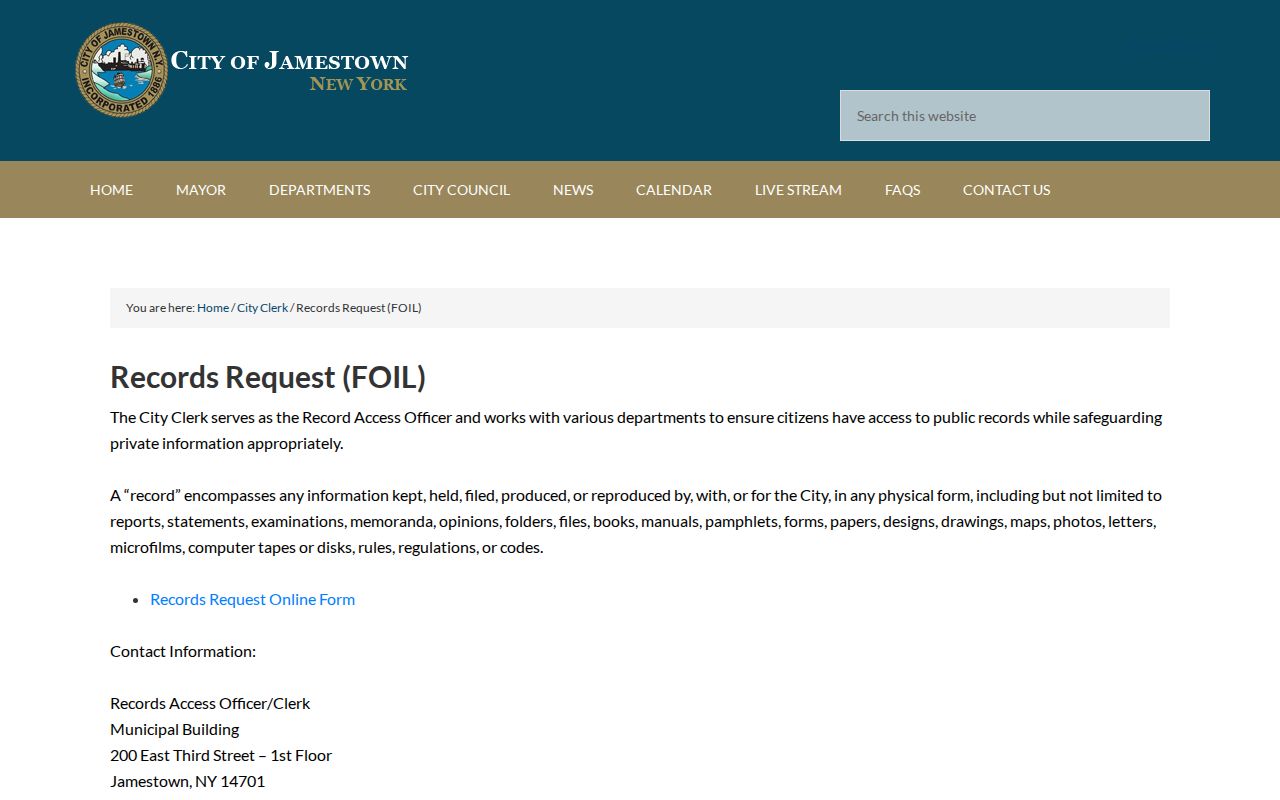
The city page shows that requesters may choose email, fax, paper, CD, DVD, USB, or an inspection appointment when the format fits the record.
Paper copies cost 25 cents per page. The city may charge actual costs when retrieval needs at least two employee hours, requires storage media, or uses an outside service. FOIL does not guarantee release of every police detail. Active-investigation material, sensitive personal data, victim information, or records covered by sealing rules can be withheld or redacted. If Jamestown denies access, the city route allows an appeal to the Mayor within 30 days.
Jamestown Arrests and Bookings
A Jamestown arrest can create several records at once. JPD makes the incident and arrest report. Jamestown City Court creates the early case record and handles local matters. If the person enters county custody, the Chautauqua County Sheriff creates the booking record. These records use different numbers and may appear at different times. A police case number will not always match a court docket or county booking identifier.
For a recent arrest, start with JPD and the official county prisoner roster. Do not begin with a statewide CHRS search if the goal is to locate a person or obtain the police narrative. The statewide court product may not yet contain the event and does not show the jail location. If an indicted felony moves forward, the later pleadings and outcome belong in Chautauqua County Court. The fuller county booking process is covered in the Chautauqua County arrest lookup.
Note: An arrest report records an allegation and police action; it does not establish guilt or prove the final charge.
Reading Jamestown Crime Records
The city keeps an annual reports and statistics archive. Official DCJS index-crime data counted 1,250 reported index offenses in 2015, 1,288 in 2016, 1,079 in 2017, and 1,045 in 2018. The 2018 total included 227 violent offenses and 818 property offenses. These are counts of reported offenses, not a list of people and not a conviction tally.
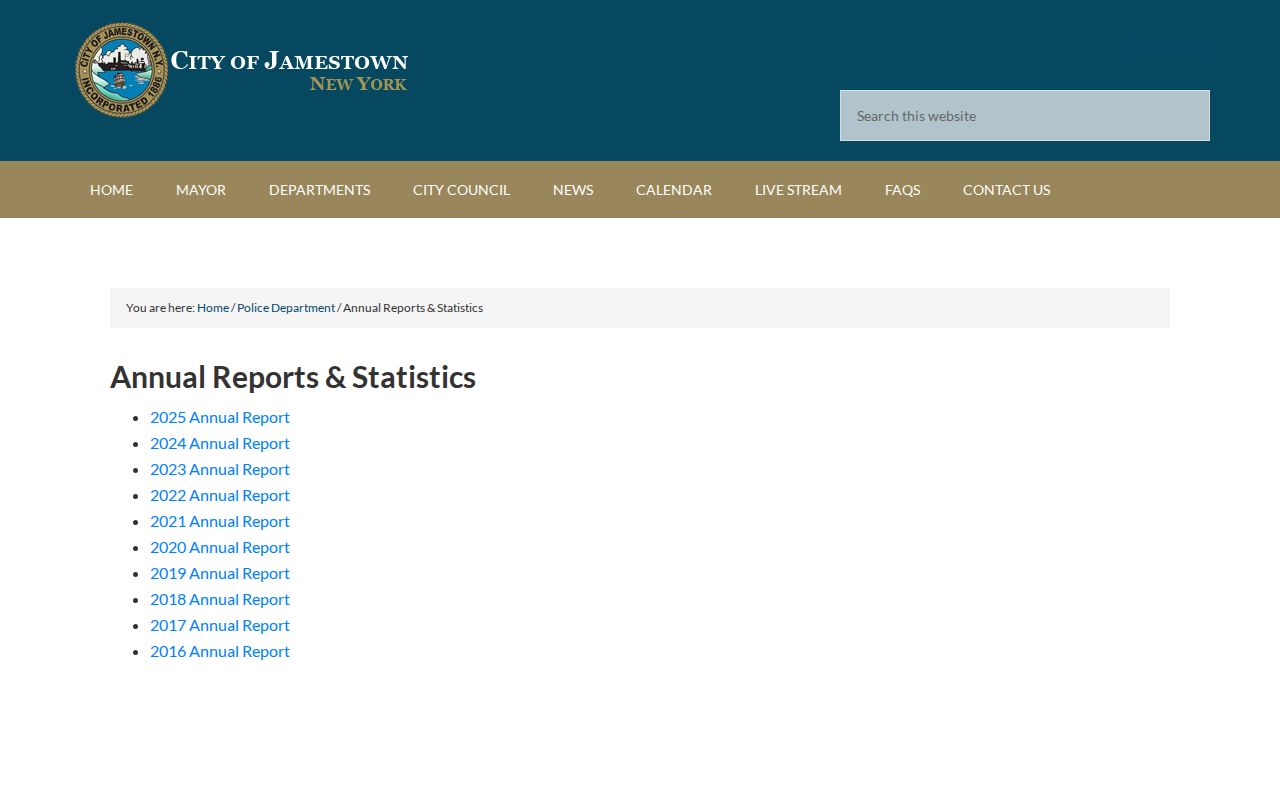
The archive gives useful city context, while an individual outcome still must be checked in the proper Jamestown court file.
A single incident may lead to no arrest, more than one arrest, or charges that later change. Likewise, one arrest cycle can contain several alleged offenses. Read a police statistic as a measure of events reported to the agency. Read an arrest record as proof of custody or enforcement action. Read the court disposition as the result of a particular prosecution.
Municipal Court Records in Jamestown
Jamestown City Court is at 200 East Third Street and is open Monday through Friday from 8:30 a.m. to 4:30 p.m. The clerk can be reached at 716-483-7561, by fax at 716-483-7519, or at JamestownCity@nycourts.gov. Judges John I. LaMancuso and George Panebianco serve the court. It handles misdemeanors and violations, conducts preliminary felony proceedings, and maintains local search, disposition, sealing, and post-sentence records.
| Court name | Jamestown City Court |
|---|---|
| Case types | Misdemeanors, violations, and preliminary felony matters |
| Lookup route | Court clerk or New York eCourts where the case is covered |
| Common fields | Defendant, docket, charge, appearance, plea, disposition, sentence, and case status |
| Best outcome record | Certificate of disposition requested from the court |
Jamestown has no city-only public case database. New York eCourts can help find an active matter, but the City Court clerk remains the source for the actual file and certified result. Sealed cases, warrants, and finished cases do not appear in WebCriminal.
Jamestown Treatment Court Records
Jamestown Treatment Court began in February 2000 as Chautauqua County's first Drug Court and Mental Health Court. It now works with the court, prosecutor, police, probation, and mental-health partners. The program may accept hub transfers. A young-adult part began in 2006, and a mental-health part followed in 2007. Current guidance favors referral at arraignment and sets a five-day screening target.
The official Treatment Court page provides the program context, and the office number is 716-483-7793. Specialty-court participation does not replace the core criminal docket. The originating court remains the source for filed charges and disposition documents. Program details may also be restricted when they contain treatment, health, or other confidential information.
For a Jamestown record search, separate the public case result from any protected treatment material. Ask the clerk for the lawful court record rather than assuming every program event is open.
Where Jamestown Records Go
City records move through a defined chain. JPD creates the police report and sends fingerprintable arrest-event information to the New York State Division of Criminal Justice Services. Jamestown City Court creates the local or preliminary case file. An indicted felony advances to Chautauqua County Court, and the county jail keeps any booking and custody entry. Courts later report dispositions so DCJS can match the result to the fingerprint-linked arrest cycle.
Record flow: Jamestown Police Department › Jamestown City Court or Chautauqua County Court › New York State Division of Criminal Justice Services
That chain explains why two official records can look different without either being false. Police charges reflect the arrest stage. Prosecutors may file different charges. A court can dismiss a count, accept a plea, or enter a verdict. Search the newest custodian for the stage in question, then use the originating court for the final case result.
Jamestown Police Record History
Jamestown's record trail reaches well beyond current databases. The department history begins with an 1855 village Nightwatch. When Jamestown became a city in 1886, its police force had six officers. Modern records now sit with a much larger department, yet older material may require an archive search rather than a routine current-file request.
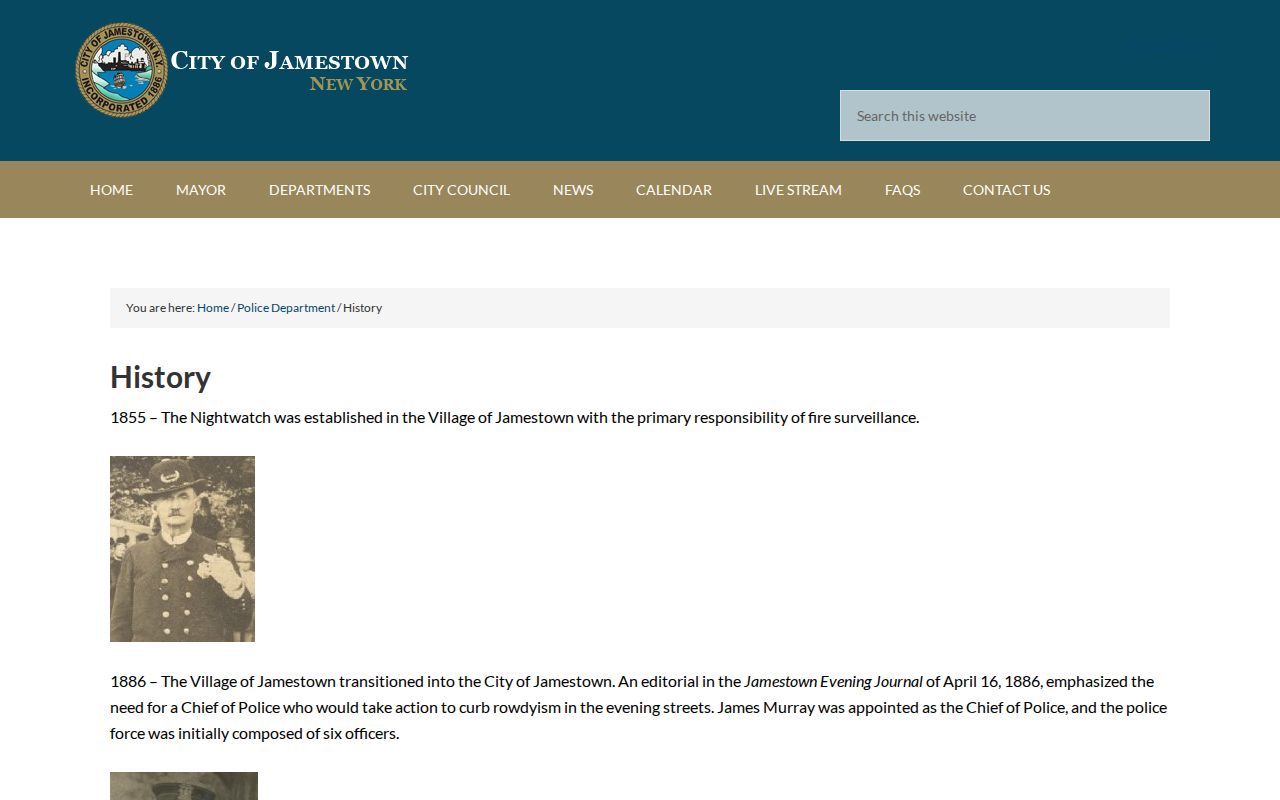
The history page places today's Jamestown records office in a long local chain of public-safety recordkeeping.
For a record from before 1995, use the city's published archive-search service and provide a narrow date range, names, and event details when known. Historical court research may follow a different path because court dockets are held by the judiciary or local archives. The police archive and court archive should not be treated as one collection.
Current Jamestown Police Records
Leadership details help confirm that a requester is using a current official source. Jamestown appointed Scott Forster police chief in April 2026 after a 16-year progression through the department and service with SWAT. The city appointment notice documents that change.
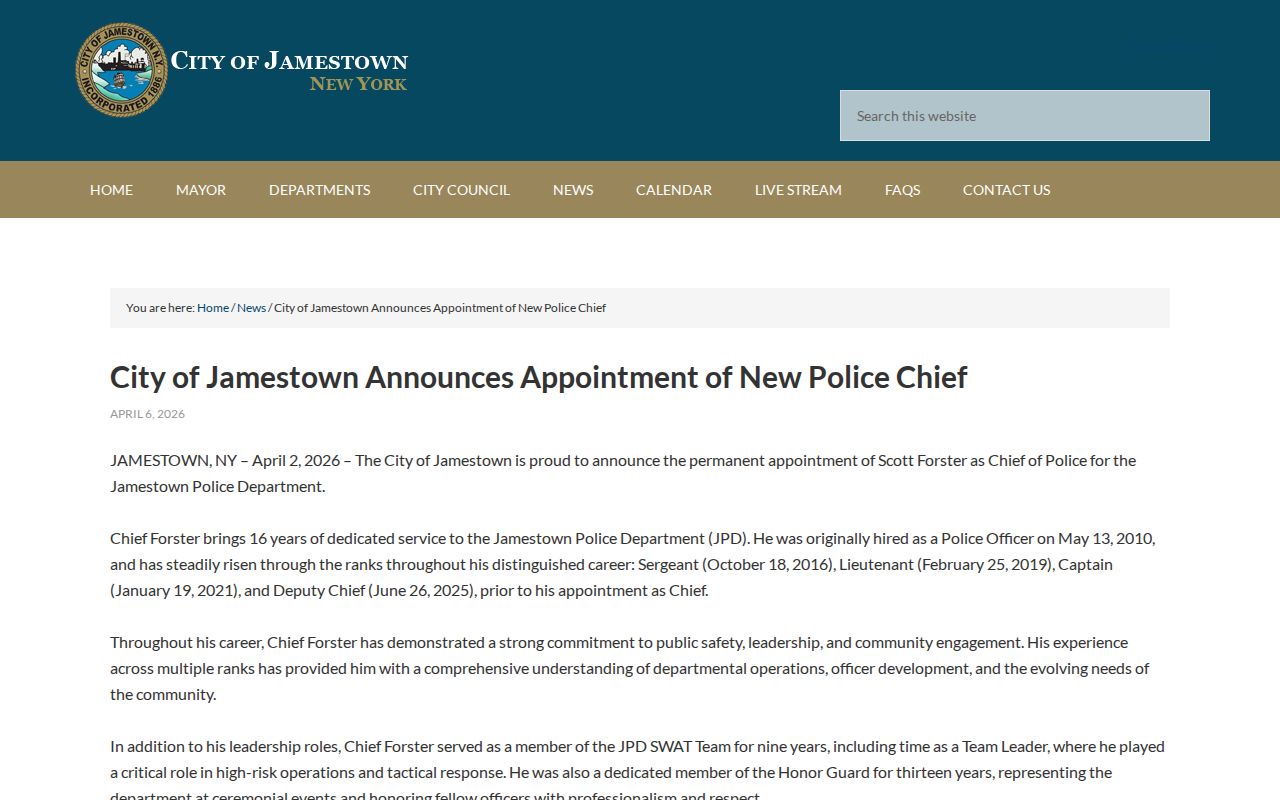
The current notice helps distinguish today's department contacts from names found on older Jamestown forms or reports.
Older records remain records of the office, not of the current chief. Direct a request to Records Management or the City Clerk route based on the record type. Personal tips and urgent reports belong on the police channels, while copies and access questions belong with the custodian.
Public Access Rules in Jamestown
Jamestown police and executive-agency records generally fall under New York's Freedom of Information Law. Court files follow judiciary access rules instead of ordinary agency FOIL. This split is practical: send a JPD report request through city channels, but ask the Jamestown City Court clerk for a court file or certificate of disposition. Both offices may withhold sealed or confidential material.
Key statutes:
Public Officers Law §87 presumes access to agency records while allowing specific privacy, investigation, fair-trial, source, technique, and safety exemptions.
Judiciary Law §255 directs court clerks to search and provide lawful copies or certifications, subject to fees and access restrictions.
CPL §160.50 generally seals records after a case ends in the accused person's favor.
Records involving minors, youthful-offender treatment, protected victim details, or sealed events may not be public. A redaction removes protected parts while leaving releasable material. When a Jamestown criminal record appears wrong, seek correction from the office that created it. Central eCourts staff cannot revise a local court entry.